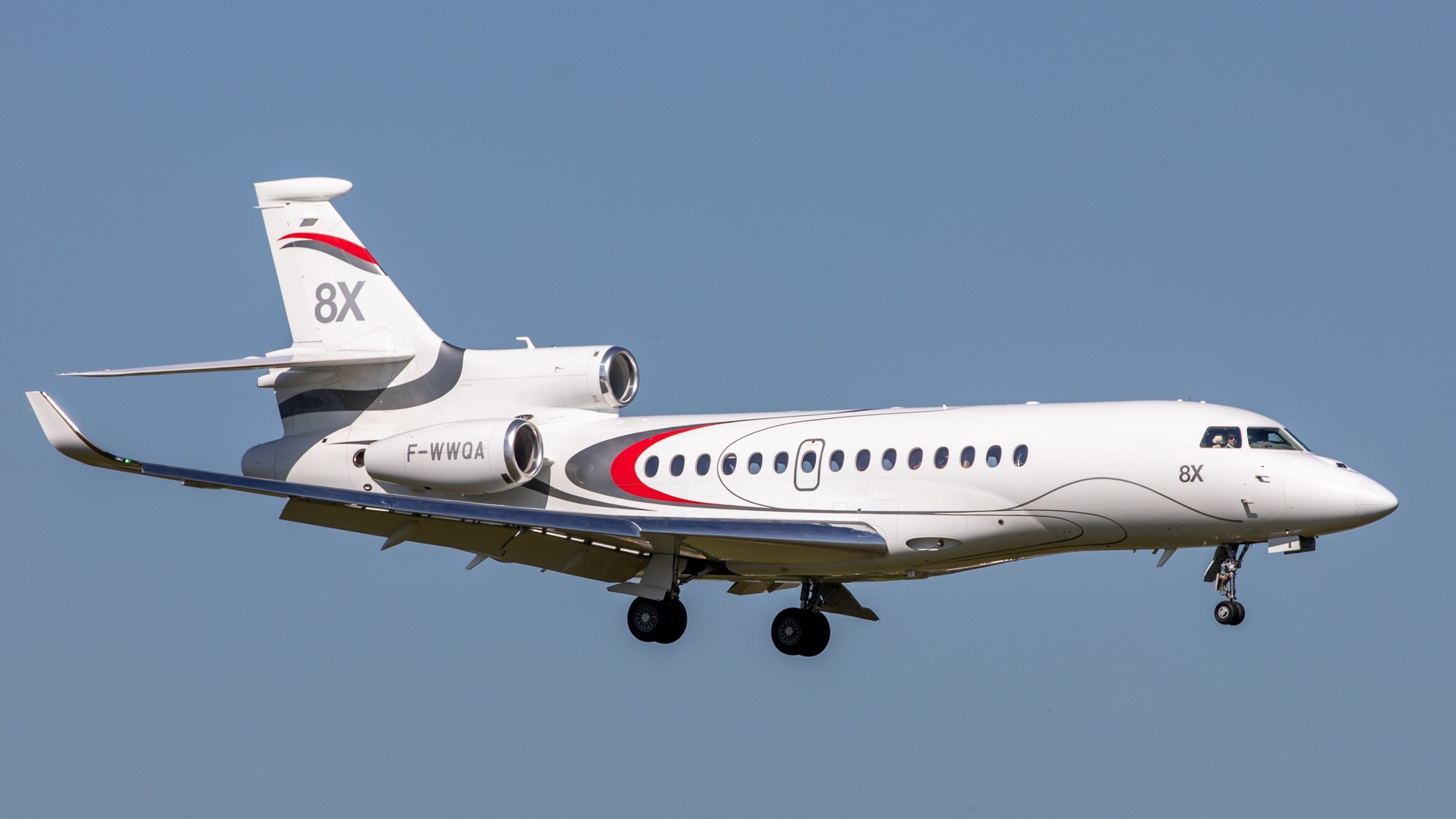
The Falcon 8X entered service in 2016. The Falcon line has used three engines since 1963, a layout that costs fuel efficiency but allows a long flight to continue after an engine failure. The 8X is among the last large trijets.
Three Pratt & Whitney PW307D engines give 6,450 nautical miles (about 11,950 km) at Mach 0.80 with a top speed of Mach 0.90. Takeoff distance is 5,940 feet. Because it has three engines, it is free of ETOPS restrictions on Atlantic crossings.
The cabin is 2.34 metres wide and 1.88 metres high, running 13 metres in three zones for up to sixteen passengers with 26 windows. Cabin altitude stays near 3,900 feet, and baggage capacity is 140 cubic feet.
The flight deck uses Dassault's EASy III system with two pilots, autoland, synthetic vision and autothrottle, and digital fly-by-wire. Dassault designed a landing distance of 2,160 feet.
The 8X is priced around 62 million dollars against the G600 and Global 6500. Its strengths are the third engine and short landing distance. On a long route a single engine failure is a serious matter, and three engines reduce that risk structurally. That simple fact keeps the aircraft selling.
CLAVES
- The Falcon 8X entered service in 2016
- Three Pratt & Whitney PW307D engines give 6,450 nautical miles at Mach 0.80
- Top speed Mach 0.90 with a 5,940-foot takeoff distance
- The cabin seats up to 16 with 26 windows
- Its three engines free it from ETOPS restrictions
Si considera que este artículo contiene un error, puede solicitar una corrección o un derecho de réplica mediante nuestro procedimiento de corrección. Escriba a [email protected].
SIGUIENTE · JET BOEING BBJ 737 MAX: an airliner turned office →