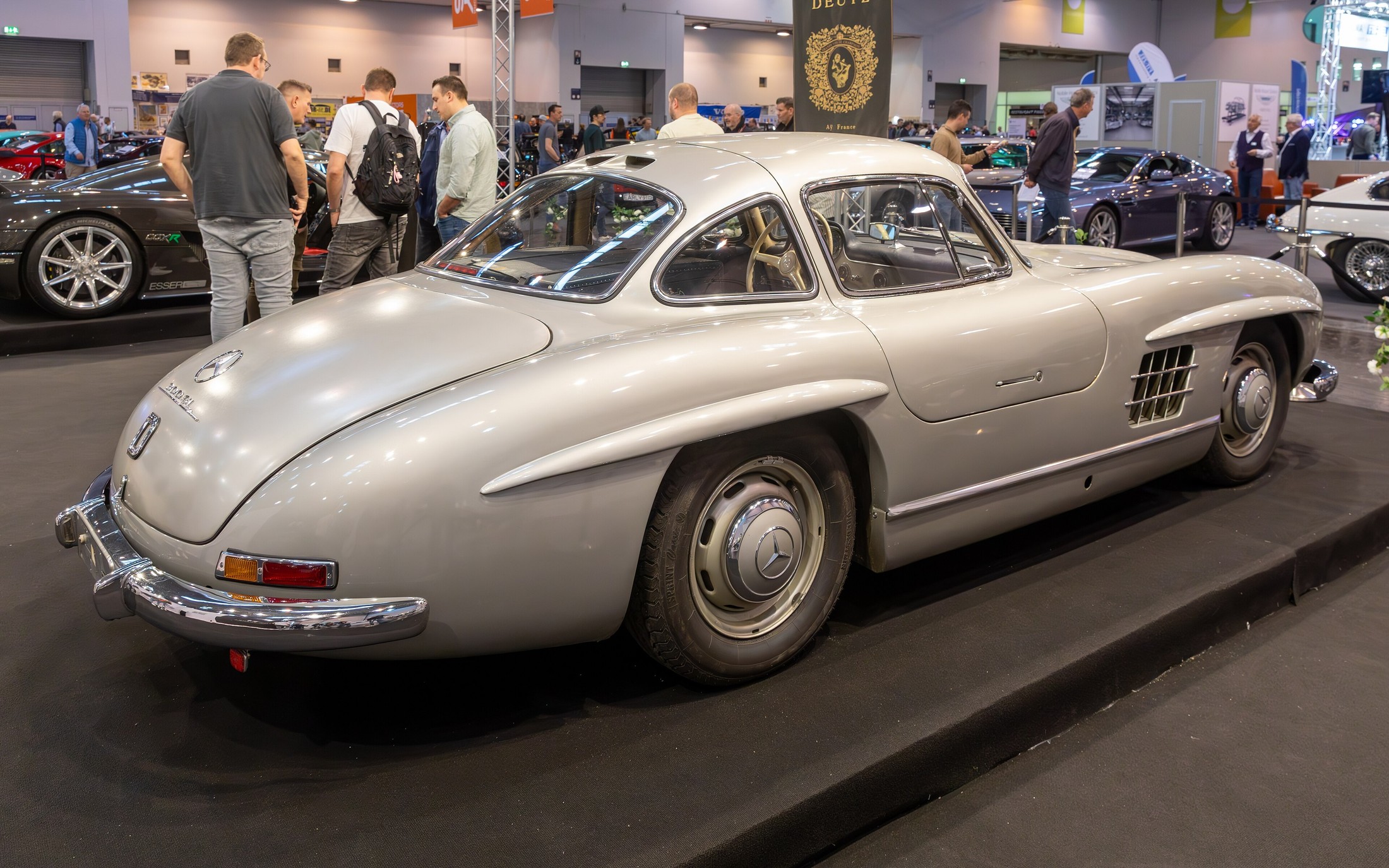
The 300 SL began as a racing car. The W194 won at Le Mans and the Mille Miglia in 1952, and the road version appeared at the New York Auto Show in 1954. Mercedes' American importer Max Hoffman proposed series production, and the company accepted — the car was built with the United States in mind.
The 3.0-litre straight-six produced 215 hp, remarkable for the period and partly the result of fuel injection; the 300 SL was among the first production cars to use direct petrol injection. A four-speed manual drove the rear wheels, and the car reached 100 km/h in about ten seconds and 260 km/h, making it one of the fastest production cars in the world.
The structure was the point. A tubular steel space frame braced in triangles gave great stiffness but left no room for conventional doors, so Mercedes hinged them into the roof. The gullwing doors were a consequence of engineering, not a flourish.
Inside, the car was practical for its time: a fitted leather luggage set in the boot, an instrument panel centred on speedometer and tachometer, thin shell seats and a large, thin-rimmed steering wheel. There was no power assistance, so steering was heavy at low speed.
About 1,400 were built by 1957, after which the Roadster arrived and sold in greater numbers. Today the Gullwing is among the most valuable classics at auction, and its value lies in structure rather than speed: the constraint of the space frame became the brand's symbol.
要点
- The 300 SL debuted at the 1954 New York Auto Show
- A 3.0-litre straight-six produced 215 hp through a four-speed manual
- Its 260 km/h top speed made it one of the fastest production cars of the era
- The gullwing doors came from the space frame's structural limits
- About 1,400 were built by 1957
この記事に事実と異なる点があると思われる場合は、訂正・反論の手続きでご請求いただけます。ご連絡は press@ateliermbent.com まで。
次の記事 · YACHT SANLORENZO 50STEEL: the first yacht to run on methanol →