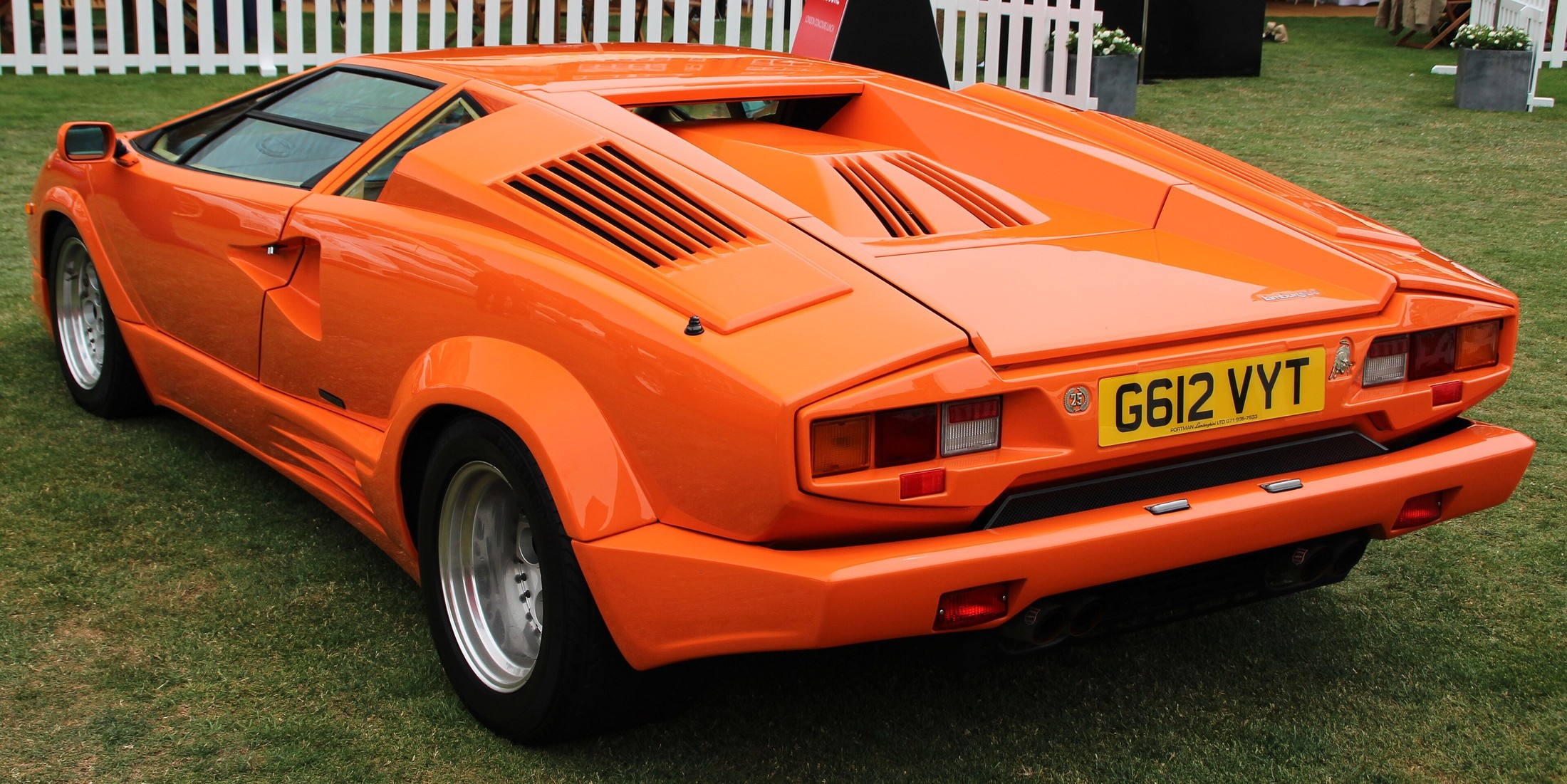
In the late 1960s LAMBORGHINI set the supercar template with the Miura, a car of curves. The Countach went the other way. Shown as the LP500 concept at Geneva in 1971, it was a wedge barely a metre tall, and many assumed it would never be built.
The LP400 used a 4.0-litre V12 producing 375 hp through a five-speed manual to the rear wheels, reaching 100 km/h in about 5.6 seconds and 290 km/h. The body was aluminium, and the earliest cars were smooth, without the wing and wide arches that came with the LP400 S.
The design came from Marcello Gandini at Bertone, who pushed the shape as sculpture rather than aerodynamics: a windscreen raked at 14 degrees, a flat roof and doors that opened upward. The doors became a LAMBORGHINI signature, though they were awkward in car parks.
The cabin was tight even by the standards of the day. The driver sits at an angle, rear visibility is close to absent, and the instrument panel is six round dials. LAMBORGHINI added three mirrors to compensate.
About 150 LP400s were built between 1974 and 1978. Today the earliest cars are the most valuable Countach variant precisely because they are smooth, narrow and wingless. What LAMBORGHINI gained from the car was not volume but identity: the wedge ran on through the Diablo, Murciélago and Aventador.
要点
- The Countach LP400 arrived in 1974 as LAMBORGHINI's second V12 model
- A 4.0-litre V12 with 375 hp, five-speed manual and rear-wheel drive
- Around 5.6 seconds to 100 km/h with a 290 km/h top speed
- Designed by Marcello Gandini at Bertone
- About 150 LP400s were built between 1974 and 1978
如认为本文与事实不符,可依更正与答辩程序提出请求。联系邮箱 press@ateliermbent.com。
下一篇 · MOTORS MERCEDES-BENZ 300 SL: why the doors open upward →