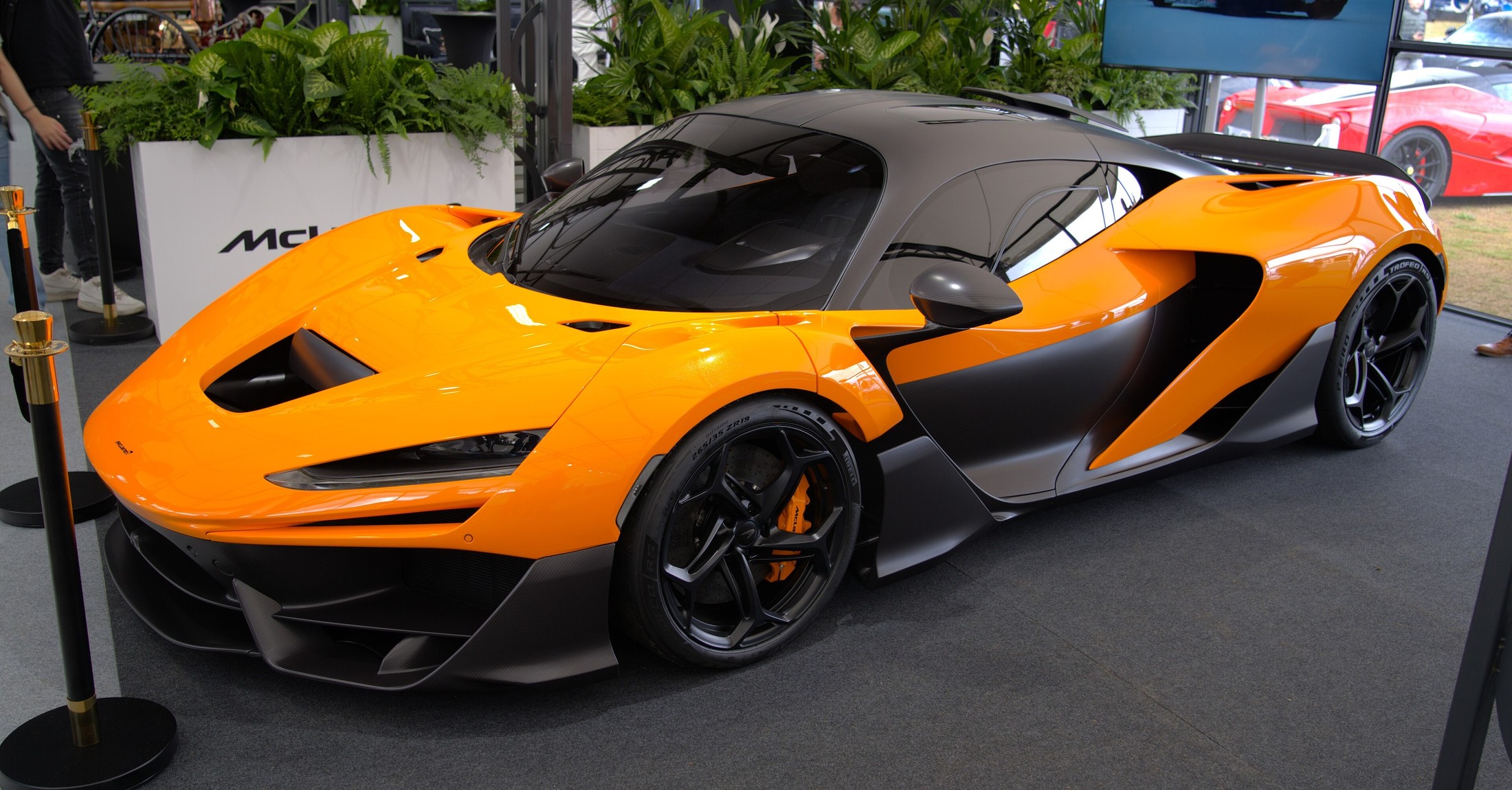
McLaren's hypercar lineage runs F1, P1, Senna. The W1 is the fourth. The letter refers to the world championship and the 1 to the F1, the company's first hypercar. McLaren describes it as carrying the spirit of that first generation, and in one measurable sense it does: the W1 is smaller and lighter than the P1.
The 4.0-litre twin-turbo V8 produces 928 hp, and a motor inside the eight-speed dual-clutch adds 347 hp for 1,275 hp (937 kW) and 1,340 Nm. McLaren quotes 2.7 seconds to 100 km/h, 5.8 seconds to 300 km/h and 350 km/h. The 1.4 kWh battery is small and fed by regeneration, giving about 2 km of electric running.
The chassis is a carbon monocoque McLaren calls the Aerocell, with front and rear subframes bolted on. Active flaps under the nose and a rear wing that extends up to 300 mm aft generate 1,000 kg of downforce at 250 km/h. Hydraulic cross-linked suspension controls roll and pitch actively.
Two people sit inside. Carbon-shell seats wear Alcantara, an 8-inch display faces the driver and a portrait touchscreen sits in the centre. McLaren kept physical controls, and suspension and powertrain modes are changed only through knobs on the wheel.
Production is limited to 399 cars at around 2 million pounds. Its rivals are the FERRARI F80, LAMBORGHINI's limited series and Porsche's hybrid hypercar. The W1's advantage is not power but weight: a dry figure of 1,399 kg is more than 100 kg below comparable cars with similar output. That is what McLaren means when it says it calculated mass before downforce.
要点
- The McLaren W1 is the successor to the P1
- A 928 hp 4.0-litre twin-turbo V8 plus a 347 hp electric motor makes 1,275 hp (937 kW)
- 0-100 km/h in 2.7 seconds, 0-300 km/h in 5.8 seconds, 350 km/h top speed
- Aerodynamics generate 1,000 kg of downforce at 250 km/h
- Limited to 399 cars with a dry weight of 1,399 kg
如认为本文与事实不符,可依更正与答辩程序提出请求。联系邮箱 press@ateliermbent.com。
下一篇 · MOTORS MCLAREN ARTURA: the balance a V6 hybrid makes possible →